


Vitamin D3 K2 Drops
- High-quality combination of Vitamin D3 and all-trans Vitamin K2 (MK-7)
- A bottle with 20ml of Vitamin D3/K2 (680 drops) corresponds to a supply for 600+ days (One serving = 1 drop)
- the majority of the population suffers from a vitamin D deficiency
-
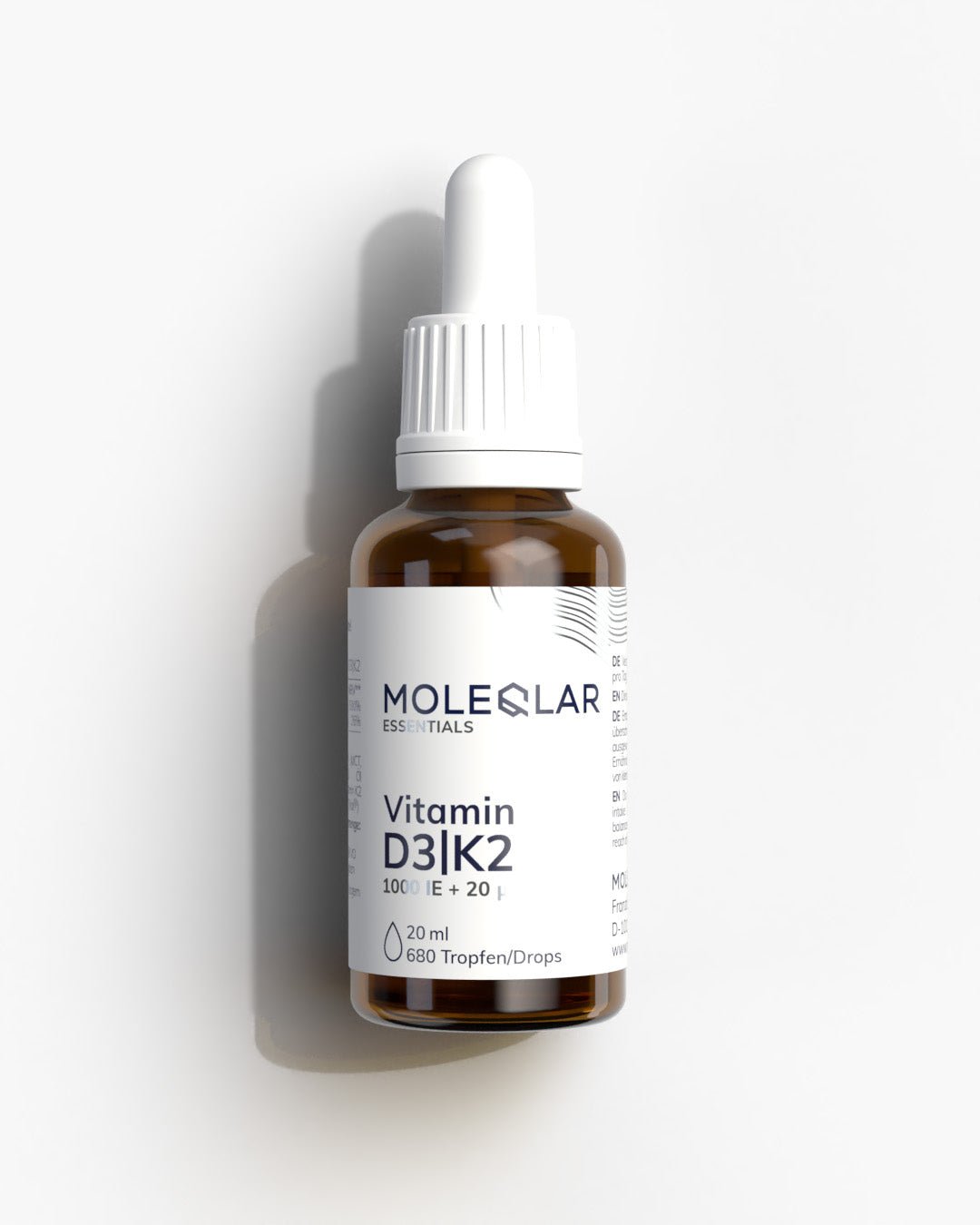 Drops
-
 Capsules
-
 ADEK complex
-
 Vitamin D Test
Your supply. Your routine.
€17,90
€51,03 €53,70
€96,66 €107,40
€182,64 €214,80
- Stay consistent: So that your routine doesn't take a break
- Plan wisely: More stock, more price advantage
Your routine. Automatically cheaper.
€16,11€17,90
- Save up to 25 %: 15 % from the 3rd delivery, 20 % from the 6th, and 25 % from the 12th delivery
- You stay flexible: Pause, cancel, or adjust delivery at any time
Your delivery interval:
€17,90
€51,03 €53,70
€96,66 €107,40
€182,64 €214,80

 Quality Promise
The MOLEQLAR "Clean Product & Label" philosophy ensures that every product arrives at you in the best quality. Each individual batch undergoes a comprehensive and product-specific purity and residue analysis (heavy metals, microbiology, pesticides).
Your legal guarantee rights

Shipping
Delivery within 1-4 working days in DE and AT. Orders placed after 12 noon will be processed on the next working day.
For more information, please visit the Shipping Information.
Quality Assurance
At MOLEQLAR, we place the highest value on transparency regarding the quality of our products. Each individual product undergoes strict testing both by our manufacturer and by independent laboratories in Germany.
Click on this link, to access the certificates directly.
Recommended intake

Developed by doctors

Manufacturing with responsibility

Certified in independent laboratories

Free from genetic engineering

Scientifically based

100% Customer-Oriented
Vitamin D3 K2 Drops at a glance
Vitamin D3 K2 Drops at a glance
What is Vitamin D3
Function
Application
Ingredients
Outstanding quality standards
High availability
A vegetarian nutrient complex for the highest demands. Certified in Germany. For maximum bioavailability, we rely on vitamin D3 in combination with all-trans K2 in MK-7 form - dissolved in the finest MCT oil.
Vitamin D3 K2 from MOLEQLAR

Broccoli as a natural source of vitamin K2

Quality Assurance
The MOLEQLAR "Clean Product & Label" philosophy ensures that every product arrives at you in the best quality. Each individual batch undergoes a comprehensive and product-specific purity and residue analysis (heavy metals, microbiology, pesticides).
Vitamin D3/K2 Drops
Vitamin D3 K2 drops facts
| Nutrients/other substances | Serving* | %NRV** |
|---|---|---|
| Vitamin D3 | 25 µg (1000 IU) | 500 % |
| Vitamin K2 MK-7 | 20 µg | 26 % |
The difference.
Quality, transparency, and scientific responsibility are non-negotiable for us.


Independent laboratory analysis
Purity of Ingredients
Transparency in raw materials
Scientific Background
Improved bioavailability


Frequently asked questions (FAQs)
Was sind Risikofaktoren für einen Vitamin D-Mangel?
Vitamin D-Mangel kommt bei ca. 50 % der Weltbevölkerung vor. Es gibt einige Risikofaktoren, die dazu beitragen können, dass Personen einen Vitamin-D-Mangel entwickeln. Dazu gehören:
- Alter: Das Risiko für einen Vitamin-D-Mangel nimmt mit zunehmendem Alter zu, da die Haut im Laufe der Zeit weniger Vitamin D produziert.
- Hautfarbe: Menschen mit dunkler Hautpigmentierung haben ein höheres Risiko für einen Vitamin-D-Mangel, da ihre Haut weniger Vitamin D produziert, wenn sie der Sonne ausgesetzt ist.
- Mangel an Sonnenlicht: Menschen, die wenig Zeit im Freien verbringen oder in Gegenden leben, in denen es wenig Sonnenlicht gibt, haben ein höheres Risiko für einen Vitamin-D-Mangel.
- Wohnort: Nördlich des 42. Breitengrades (Rom und Boston) ist das UV-Spektrum in den Wintermonaten (Oktober bis März) sehr ungünstig. In diesen Monaten kann von Bewohnern der nördlichen Hemisphäre praktisch kein Vitamin D3 gebildet werden, wodurch schwere Mangelzustände auftreten können. Ebenso tragen die zunehmende Urbanisierung und Luftverschmutzung zu einer eingeschränkter Sonnenlichtexposition bei.
- Gewicht: Übergewichtige Menschen haben möglicherweise ein höheres Risiko für einen Vitamin-D-Mangel, da Vitamin D in ihrem Fettgewebe gebunden ist und somit weniger im Blut verfügbar ist.
- Einschränkungen der Nahrungsaufnahme: Menschen, die aufgrund von Krankheit oder Behinderung nicht in der Lage sind, eine ausreichende Menge an Nahrung zu sich zu nehmen, können einen Vitamin-D-Mangel entwickeln.
- Medikamente: Einige Medikamente, wie Kortikosteroide und Antiepileptika, können das Risiko für einen Vitamin-D-Mangel erhöhen.
- Lebensstilfaktoren: Rauchen und übermäßiger Alkoholkonsum können das Risiko für einen Vitamin-D-Mangel erhöhen.
Welche Personen sind von einem Vitamin D-Mangel besonders betroffen?
Anhand der zuvor aufgezählten Risikofaktoren gibt es folgende Personengruppen, die besonders auf ihren Vitamin-D-Spiegel achten sollten:
- Schwangere & Stillende
- Säuglinge, Kinder & Jugendliche
- ältere Personen
- Schichtarbeiter
- Dunkelhäutige
- Raucher
- Personen, die sich verhüllen
Was sind Anzeichen für einen Vitamin D-Mangel?
Ein Vitamin-D-Mangel kann sich auf verschiedene Weise bemerkbar machen. Mögliche Symptome sind:
- Müdigkeit und Erschöpfung
- Muskelschwäche und -schmerzen
- Störungen bei der Knochenbildung, die zu Rachitis bei Kindern oder zu Osteomalazie bei Erwachsenen führen können
- Ein erhöhtes Risiko für Infektionen
- Depressionen
- Eine verringerte Fähigkeit, Schmerzen zu tolerieren
Wenn du bemerkst, dass eines oder mehrere dieser Symptome auf dich zutreffen, sollten du an einen möglichen Vitamin-D-Mangel denken. Es ist wichtig einen Arzt aufzusuchen, um sicherzustellen, dass keine anderen Gesundheitsprobleme vorliegen.
Wie stelle ich eine ausreichende Vitamin D-Versorgung sicher?
Eine ausreichende Vitamin-D-Versorgung lässt sich auf folgende Weise sicherstellen:
- Sonnenexposition: Der beste Weg, um Vitamin D zu produzieren, ist, sich der Sonne auszusetzen. Die Haut produziert Vitamin D, wenn sie der UVB-Strahlung der Sonne ausgesetzt ist.
In unseren Breitengraden herrschen die optimalen Bedingungen zur Vitamin D Bildung zwischen April und September, in der Zeit von 10 bis 15 Uhr. Idealerweise sollte in diesem Zeitraum jeden Tag ein Viertel der Haut (Gesicht, Hände, Teile von Armen und Beinen) ohne Sonnenschutz für 5 bis 25 Minuten (je nach Jahreszeit und Hauttyp) der Sonne ausgesetzt sein. Dabei gilt unbedingt auf den Schutz der Haut zu achten und ein Sonnenbrand zu vermeiden! Einfache Merkregel: Ist der Schatten länger als man selbst, ist keine ausreichende Vitamin-D-Synthese zu gewährleisten! - Nahrungsergänzungsmittel: Vitamin-D-Präparate sind in Form von Kapseln, Tabletten oder Tropfen erhältlich und können eine gute Ergänzung sein, um den Vitamin-D-Spiegel zu erhöhen. Es ist jedoch wichtig, dass die Einnahme von Nahrungsergänzungsmitteln immer mit einem Arzt oder einer Ärztin besprochen wird, um mögliche Überdosierungen zu vermeiden. Menschen, die sich aus unterschiedlichen Gründen bei Sonnenschein nur wenig oder gar nicht im Freien aufhalten bzw. nur mit gänzlich bedecktem Körper in die Sonne gehen, sowie Menschen mit dunkler Hautpigmentierung wird laut den D-A-CH-Ernährungsgesellschaften die Einnahme eines Vitamin-D-Präparats (Supplement) empfohlen.
- Vitamin-D-reiche Lebensmittel: Einige Lebensmittel enthalten natürlicherweise Vitamin D, darunter Fettfische wie Lachs und Hering, Eier, Pilze und Lebertran. Es ist jedoch schwierig, ausreichend Vitamin D aus der Nahrung allein zu beziehen, weshalb die Einnahme von Nahrungsergänzungsmitteln oder eine ausreichende Sonnenexposition empfohlen wird.
Wie sollte ich Vitamin D3/K2 lagern?
Vitamin D3/K2 sollte am besten kühl und trocken gelagert werden. Auch aus direktem Sonnenlicht und von Hitze fern halten. Bitte außerhalb der Reichweite von Kindern aufbewahren.
Wie lange ist mein Einkauf haltbar?
Prinzipiell kann man von einer Haltbarkeit von ungefähr zwei Jahren ausgehen. Diese Angabe dient lediglich als Richtwert, kann demnach variieren und ist ohne Gewähr. Das genaue Mindesthaltbarkeitsdatum deines Einkaufs findest du am Boden der Vitamin D3/K2-Flasche beziehungsweise der Verpackung notiert.
Related items from the magazine


